
Diagnostics
Diagnostics is the analytical layer of the Bio‑Ionic System. Its purpose is to read the ionic architecture of living tissue and translate it into a clear, interpretable map of the body’s real physiological state. Instead of relying on symptoms or biochemical markers, Diagnostics works directly with the structure of ionic fields, where the earliest signs of imbalance appear.
At its core, this system identifies three fundamental elements within any tissue:
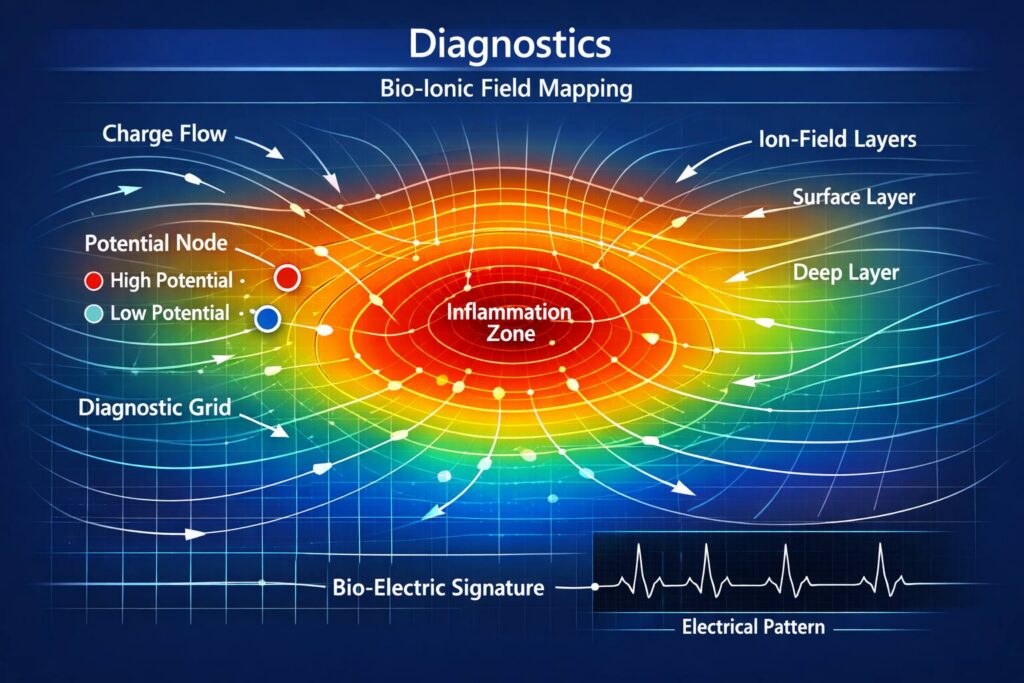
- Ion‑Field Geometry — the spatial layout of potentials and conductive pathways
- Charge‑Flow Dynamics — how ionic currents behave under healthy or disturbed conditions
- Bio‑Electric Signatures — the unique electrical identity of each tissue
When these structures shift, even subtly, Diagnostics detects the change long before conventional methods can. In this framework, a “disease” is understood not as a set of symptoms but as a distortion in ionic architecture.
Diagnostics also functions as the central reference point for all other divisions of the Bio‑Ion System.
It provides:
- Pre‑Reset Mapping for ILC Reset
- Regeneration Tracking during tissue recovery
- Signal‑Level Correction before therapeutic intervention
This makes Diagnostics an active, guiding component rather than a passive measurement tool.
In the defense layer of RenergyAI, Diagnostics extends its role to field‑level monitoring. It identifies:
- Ionic intrusions
- Bio‑electric tampering
- Signal‑based threats
Using the same ILC–ISN principles, but applied to stability and security. Ultimately, Diagnostics forms the interpretive backbone of the entire Bio‑Ionic System. It converts raw ionic activity into structured knowledge — enabling precise therapy, continuous regeneration monitoring, and advanced field‑level protection.
1) Theoretical Layer
Diagnostics is the analytical core of the Bio‑Ionic System.
It interprets the ionic architecture of living tissue — the geometry of fields, charge‑flow patterns, and bio‑electric signatures — to reveal the true physiological state long before symptoms appear.
Every tissue expresses a unique ionic identity defined by:
- Ion‑Field Geometry — spatial structure of potentials and conductive routes
- Charge‑Flow Dynamics — how ionic currents behave in healthy vs. disturbed states
- Bio‑Electric Signatures — the electrical fingerprint of each tissue
In this model, disease is not a biochemical label — it is a distortion in ionic architecture.
Takeaway
Regeneration and degeneration both begin as field‑level events, not chemical ones.
2) Data‑Flow Architecture
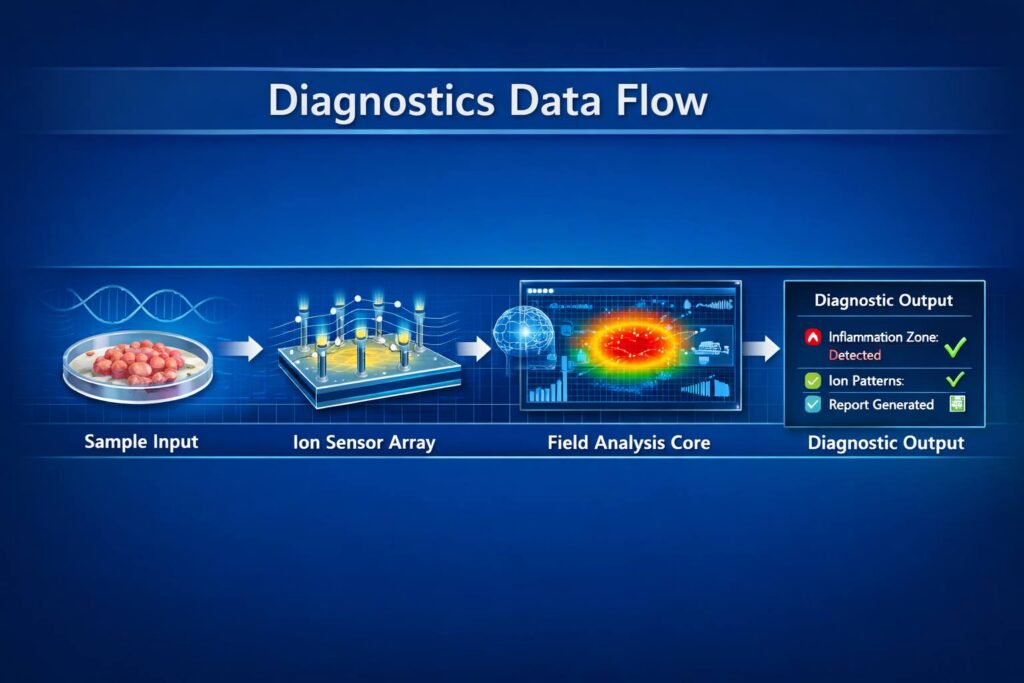
This micro‑diagram shows the operational pathway of Diagnostics:
- Sample Input → biological or cellular sample
- Ion Sensor Array → capturing ionic activity
- Field Analysis Core → extracting field geometry and signatures
- Diagnostic Output → generating the ionic state map
This flow is the backbone of all measurement and interpretation inside RenergyAI.
3) UI‑Overlay Layer
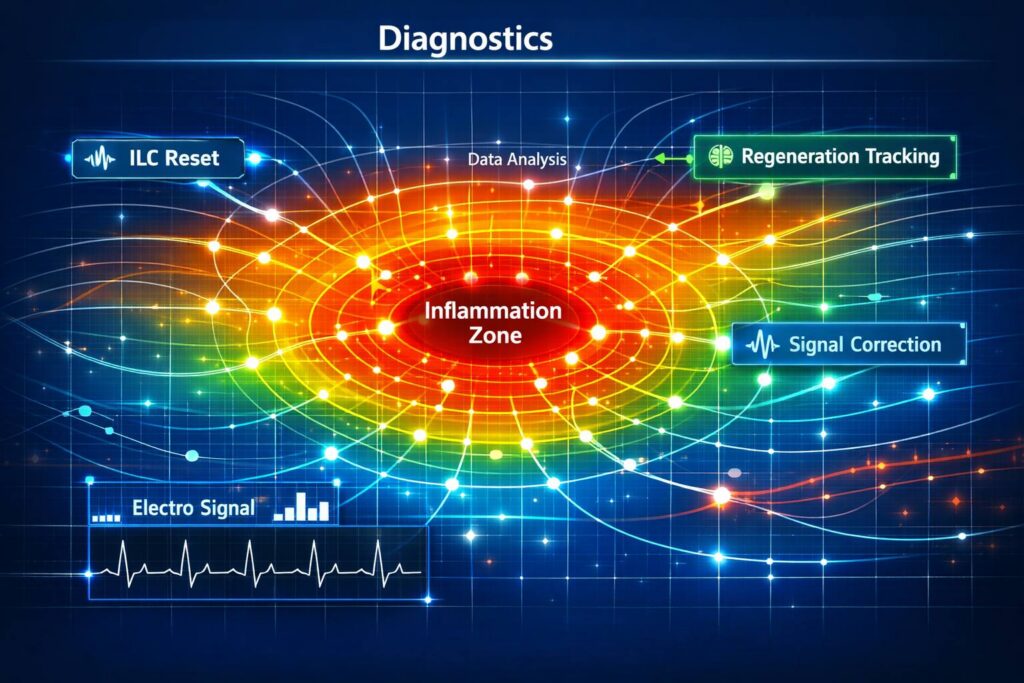
The interactive overlay adds a live, system‑level view of ionic behavior:
- ILC Reset Node — field disruption detection
- Regeneration Tracking Node — monitoring recovery
- Signal Correction Node — identifying misaligned ionic patterns
- Dynamic Grid — real‑time field mapping
- Electro‑Signal Panel — waveform‑based analysis
This layer turns Diagnostics into a living interface rather than a static measurement.
4) Therapeutic Integration (Patent Pending)
Diagnostics guides all therapeutic modules:
- Pre‑Reset Mapping for ILC Reset
- Regeneration Tracking during tissue repair
- Ion‑Signature Correction before intervention
It ensures that therapy is not generic — it is field‑specific and tissue‑specific.
Takeaway
When the ionic field is restored, the cell activates its own repair program — no genetic manipulation required.
5) Defense Layer (Patent Submission Notice)
Diagnostics also functions as a field‑level security system:
- Ion‑Shield Detection
- Field Intrusion Monitoring
- Bio‑Electric Tampering Alerts
- Anti‑Degeneration Mode
Takeaway
Regeneration is a proactive defense architecture, not a passive response.