
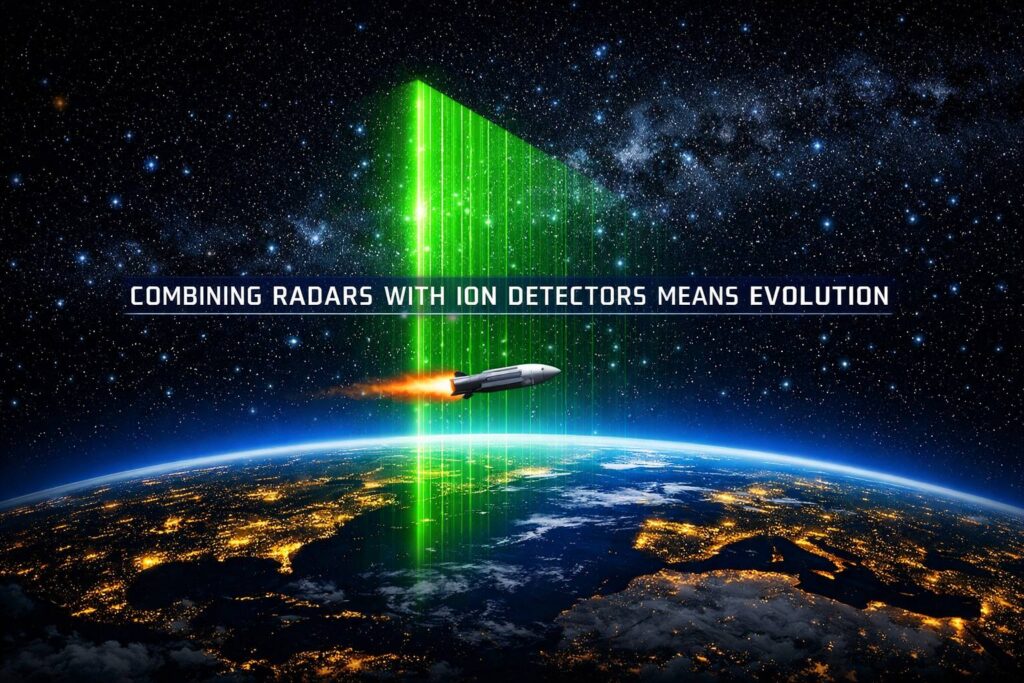
Modern defense systems are facing a new generation of challenges. Advances in maneuverable missiles, micro‑drones, low‑signature quadcopters, and autonomous aerial platforms have exposed clear limitations in traditional detection technologies. Systems that rely on reflected signals, radar cross‑sections, or optical tracking struggle when the threat becomes smaller, faster, quieter, and deliberately engineered to evade conventional sensors.
This shift has created the need for a different kind of awareness one that does not depend on artificial signals, but on the natural physics of the atmosphere itself.
At RenergyAI, our defense work is built on a simple idea: the ion field of the atmosphere reacts to everything that moves through it. Any object, any motion, any abnormal event leaves a measurable disturbance in the surrounding ionic environment. These disturbances form recognizable patterns what we call ion signatures.
Our system monitors these subtle variations and interprets them as indicators of activity in the airspace. It does not emit signals, it does not wait for reflections, and it cannot be blinded by electronic countermeasures. It reads the environment as it is.
The volume of ion‑field data is enormous, and for many years this made real‑time analysis impractical. But the combination of modern GPUs and advanced AI models has changed what is possible. High‑density parallel processing allows the system to evaluate ion‑field fluctuations in fractions of a second, while machine‑learning models classify the resulting signatures with remarkable precision.
This coupling of physics‑based sensing with high‑performance computation creates a fast‑reaction defensive layer capable of detecting even small and low‑profile threats.
Our design philosophy is straightforward: a defense system should rely on phenomena that cannot be switched off, jammed, or hidden. The atmospheric ion field is one of those phenomena. It is always present, always active, and always responsive to motion. By reading its behavior, we gain a form of situational awareness that is fundamentally different from conventional sensing.
Because of the sensitive nature of this technology, the information presented here reflects only the scientific foundations and the conceptual architecture of the system. Operational details, implementation methods, and technical specifications are intentionally withheld to avoid creating security risks.
What we share publicly is the vision: a new defensive capability built on the natural structure of the atmosphere — a system that interprets ion signatures to reveal abnormal disturbances in real time.