
Geo Health
Understanding the Ionic Health of the Earth — A New Layer of Climate Intelligence
Across the planet, climate behavior is interpreted through temperature, humidity, rainfall, and atmospheric chemistry. Yet beneath these familiar indicators lies a deeper and largely overlooked layer: the ionic field architecture of the Earth. This architecture governs how wind forms, how rainfall stabilizes, how dust emerges, and why certain regions drift toward drought while others remain resilient.
Geo Health at RenergyAI is dedicated to studying, modeling, and restoring this ionic layer
not as a theoretical exercise, but as a foundation for economic, environmental, and climate‑stability technologies.
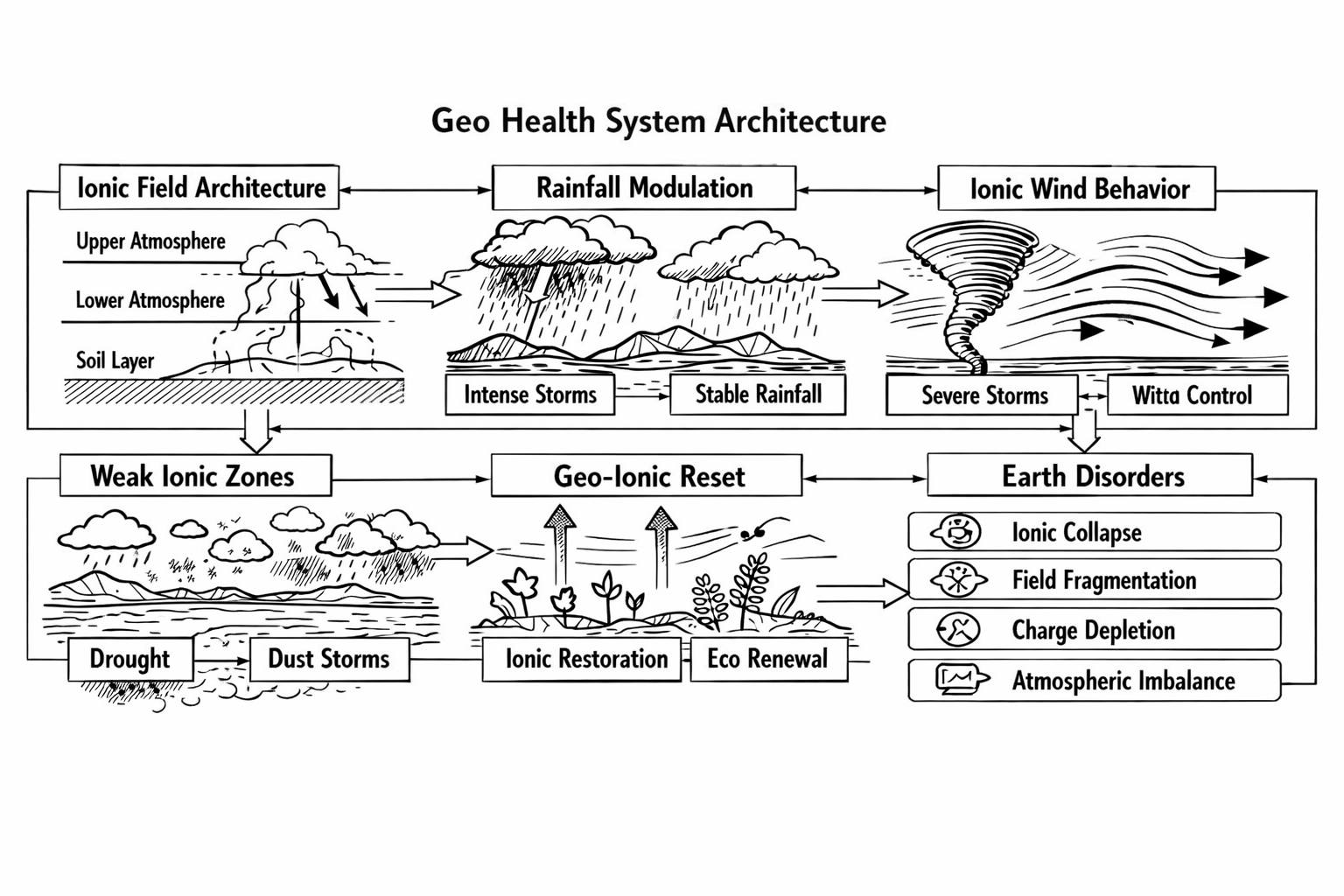
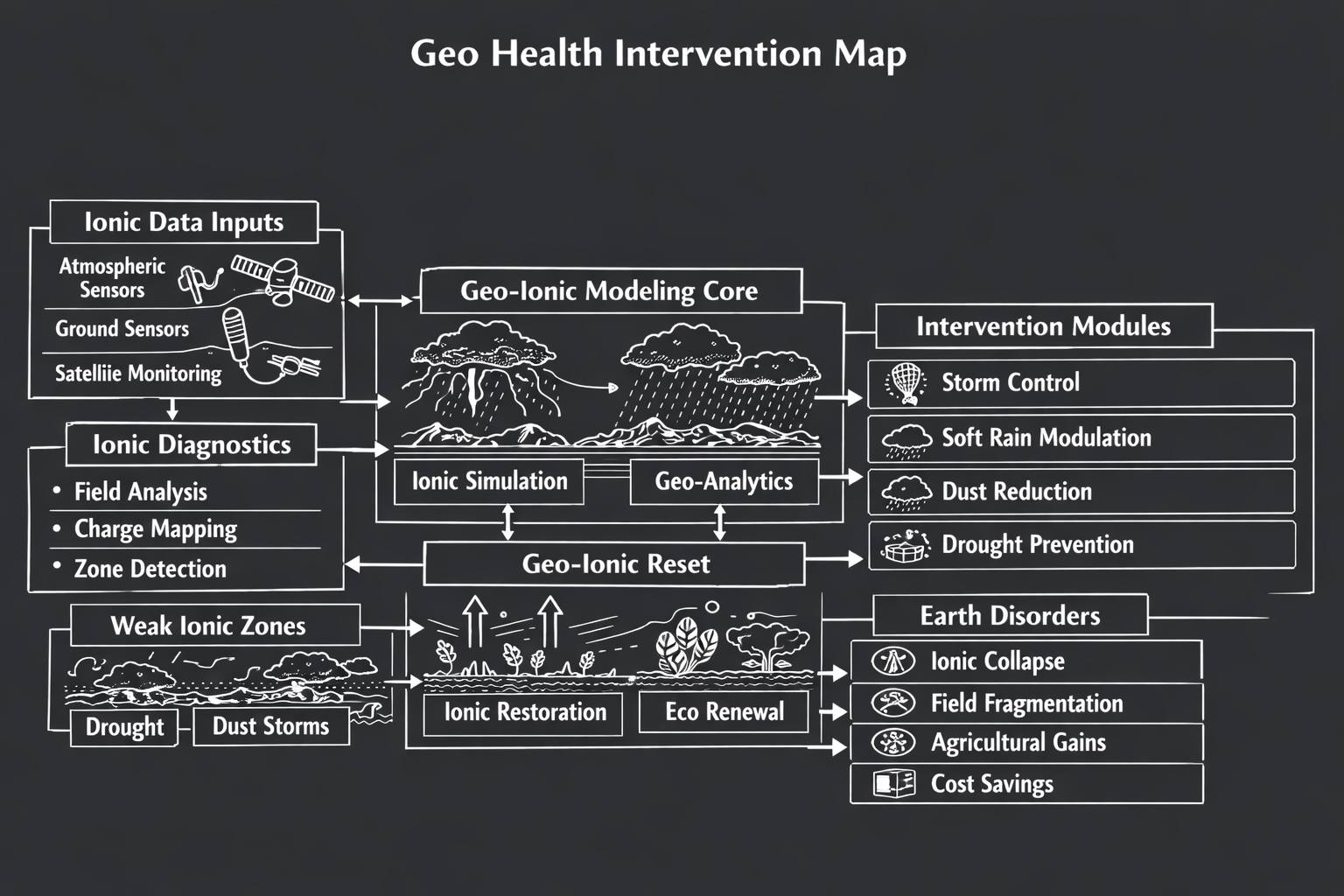
Ionic Field Architecture — The Hidden Electrical Framework of the Planet
The Earth operates through a multi‑layered ionic structure spanning:
- the soil surface
- the lower atmosphere
- the mid‑atmospheric layers
This structure behaves like a distributed signaling network.
When it is stable, climate patterns remain predictable.
When it collapses or fragments, the consequences appear as:
- erratic winds
- sudden rainfall bursts
- persistent drought
- dust storms
- regional climate instability
Geo Health focuses on mapping and quantifying this architecture to identify where and why disruptions occur.
Ionic Stability & Rainfall Modulation — Turning Extreme Rain into Soft Rain
MRainfall is not governed by moisture alone. It is governed by ionic balance.
When ionic stability is high:
- rainfall becomes soft, continuous, and agriculturally beneficial
When ionic stability collapses:
- rainfall becomes rapid, destructive, and flood‑forming
This insight forms the basis for RenergyAI’s work on:
- flood prevention
- controlled rainfall enhancement
- water‑resource optimization for agriculture
Geo Health provides the scientific backbone for these interventions.
Ionic Wind Behavior — A New Approach to Storm and Wind Control
Wind is not merely the movement of air. it is the movement of charged particles within air.
When Ion Drift becomes unstable:
- storms intensify
- wind paths shift unpredictably
- dust storms form and expand
By analyzing ionic gradients and drift patterns, Geo Health enables technologies that can:
- reduce storm intensity
- stabilize wind behavior
- prevent the formation of destructive dust systems
This creates a new category of climate‑defense solutions.
Weak Ionic Zones — The Ionic Origin of Drought and Dust
Regions with depleted ionic fields—known as Weak Ionic Zones—exhibit:
- reduced rainfall
- persistent dryness
- soil instability
- high dust generation
- long‑term ecological decline
These zones are not random; they are ionic failures.
Geo Health identifies, maps, and models these zones to support:
- land restoration
- dust‑storm mitigation
- drought prevention
- climate‑risk forecasting
This transforms Geo Health into a tool for economic resilience.s.
Geo‑Ionic Reset — Restoring the Earth’s Natural Reset Mechanism
Just as biological cells rely on ionic resetting to maintain function, the Earth also depends on a natural ionic reset cycle.
When this reset is disrupted:
- rainfall patterns collapse
- winds destabilize
- soil loses structure
- ecosystems degrade
RenergyAI develops methods to restore or enhance this reset, enabling:
- revival of rainfall
- stabilization of local climates
- reduction of dust and soil erosion
- recovery of degraded lands
This is the foundation for climate‑restoration technologies.
Earth Disorders — A New Scientific Language for Climate Instability
Geo Health introduces a diagnostic framework for understanding ionic disruptions, including:
- Ionic Collapse — loss of field strength
- Field Fragmentation — broken or scattered ionic pathways
- Charge Depletion — insufficient surface or atmospheric charge
- Atmospheric Ion Imbalance — unstable ionic composition in the air
These “Earth Disorders” provide a structured way to:
- diagnose climate risks
- design targeted interventions
- build predictive climate‑intelligence models
This framework is essential for governments, industries, and climate‑risk platforms.
Why Geo Health Matters for the Future of Climate Technology
Geo Health is not a theoretical discipline. It is a new economic and technological frontier.
Its applications include:
- flood‑risk reduction
- storm‑intensity control
- rainfall stabilization
- dust‑storm prevention
- agricultural climate optimization
- drought mitigation
- land restoration
- climate‑risk modeling for national and industrial planning
By revealing the ionic layer of the Earth, Geo Health enables solutions that were previously impossible.